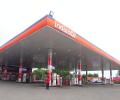
Petrol price on Monday neared Rs 100-a-litre mark in the national capital after the rate was hiked yet again. Petrol price was increased by 35 paise per litre while there was no change in diesel rates, according to a price notification from state-owned fuel retailers. In Delhi, the petrol price soared to Rs 99.86 per litre. Diesel rates were unchanged at Rs 89.36.
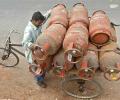
In five monthly reduction, non-domestic LPG rates have been slashed by Rs 170.5 per cylinder, bringing the price at three-year lows.

Amid record-high fuel prices, Finance Minister Nirmala Sitharaman on Monday said there is no proposal as of now to bring crude oil, petrol, diesel, jet fuel (ATF) and natural gas under the Goods and Services Tax (GST). When the GST was introduced on July 1, 2017, amalgamating over a dozen central and state levies, five commodities - crude oil, natural gas, petrol, diesel, and aviation turbine fuel (ATF) - were kept out of its purview given the revenue dependence of the central and state governments on this sector. This meant that the central government continued to levy excise duty on them while state governments charged VAT. These taxes, with excise duty, in particular, have been raised periodically.

While India won't be immune to global spillovers, we need to create the macro preconditions for sustained growth. Policy agility, prudence, and resilience will be key, suggests Sonal Varma.

'I'm pitching India for the strengths we offer, including the English language, engineers, doctors, nurses, professionals, innovative talent of startups.'

'There are occasions when the prices of individual items like food raise inflation; then supply-side measures must be taken.' 'But if there is continued inflation, it means liquidity is aggravating the situation.'
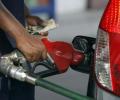
Petrol and diesel prices were hiked for the fourth consecutive day on Saturday by 35 paise per litre, pushing the total increase in rates on petrol to Rs 36 per litre and on diesel to Rs 26.58 since early May 2020 when taxes on the two fuels were raised to record levels. Petrol in Delhi now costs Rs 107.24 a litre and diesel comes for Rs 95.97, according to a price notification of state-owned fuel retailers. The latest increase that follows the unrelenting hike in international oil prices has pushed pump rates across the country to their highest-ever levels.

Amid an outcry over record high petrol and diesel prices, Union Finance Minister Nirmala Sitharaman on Saturday said the Centre and state governments will have to together work out a mechanism to bring retail rates to reasonable levels.

'While collections under the Income Disclosure Scheme explain it partly, indirect tax numbers not showing any effect of the withdrawal of high denomination currency notes was puzzling.'

Government-controlled oil-marketing companies (OMCs) have held back petrol and diesel price revisions for a week and are expected to continue doing so, ostensibly owing to political reasons. It appears that the Centre has informally conveyed to the three major OMCs to not revise fuel prices for the time being, two people in the government said. This informal directive follows the talks between the Centre and states on cutting taxes and bringing the auto fuels under the good service tax regime not fetching the desired results, so far.

The RBI on Friday said maiden Sovereign Green Bonds (SGrBs) would be issued in two tranches for an aggregate amount of Rs 16,000 crore, and proceeds will be utilised for funding public sector projects seeking to reduce carbon emissions. The first auction would be done on January 25 while the second on February 9, the Reserve Bank of India (RBI) said in a statement. The proceeds will be deployed in public sector projects, which help in reducing the carbon intensity of the economy, it said.

Announcing a Re 1 crop insurance scheme for farmers, the deputy CM said the government will bear the financial burden of Rs 3,312 crore.

There has been a sharp recovery in the headline corporate earnings in the April-June 2023 quarter (Q1FY24), after a dismal showing by early bird companies. The combined net profit of the 983 listed companies that have declared their quarterly results, so far, was up 64.7 per cent year-on-year to record a high of Rs 2.68 trillion in the first quarter, but growth in earnings remained lopsided because most of the incremental gains came from a handful of companies. Moreover, the quarterly numbers showed a continued slowdown in revenue growth.

GST is levied on every transaction in the supply of goods and services, barring certain exempted items

The headline for corporate profit growth has been very encouraging in the July-September quarter (Q2) of 2023-24 (FY24), with the combined net profit of listed companies up by 38 per cent year-on-year. However, the earnings distribution has been very lopsided, with most of the growth coming from public-sector oil-marketing companies (OMCs), banks, non-bank lenders, automobile (auto) companies, and cement producers. By comparison, companies from information technology services, fast-moving consumer goods (FMCG), retail, and consumer durables were disappointed, experiencing a sharp slowdown in net sales growth and a relatively muted increase in reported net profit.

Cement companies posted mixed figures for the first quarter of the 2023-24 financial year (Q1FY24). Volume growth was robust at 17 per cent year-on-year (Y-o-Y) - on an aggregate basis - for 15 cement companies, with revenue growth at 15 per cent. Aggregate earnings before interest, taxes, depreciation, and amortisation (Ebitda) were up 8.8 per cent Y-o-Y and 1.2 per cent quarter-on-quarter (Q-o-Q).

Deora, who met Mukherjee on Monday afternoon to present his ministry's Budget wishlist, also discussed the deregulation of fuel prices.

The government should take measures to promote innovation and R&D while simplifying regulations for the sector in the upcoming Union Budget, as per pharmaceutical industry bodies. Outlining the wish list for the sector in the upcoming Union Budget, Indian Pharmaceutical Alliance (IPA) secretary general Sudarshan Jain said the domestic pharma industry is currently around $50 billion in size and aspires to grow to around $130 billion by 2030 and $450 billion by 2047. "To achieve this vision, the Union Budget 2023-2024 should help fuel innovation and R&D, which will set the pace for propelling the pharmaceutical industry forward," he told PTI.

In an hour-long chat on rediff.com on Friday, financial planning expertTrideep Choudhary offered some valuable investment tips.

In Mumbai, jet fuel costs Rs 71,940.36 per kl as against Rs 73,306.89 per kl previously, IOC said.

Finance Minister Nirmala Sitharaman on Wednesday said the government is keeping an eye on inflation which is purely "extraneous" nowadays because of fuel and fertiliser prices. Replying to the debat on the Supplementary Demands for Grants in the Rajya Sabha, the minister said wholesale inflation has fallen to a 21-month low. Later, the Rajya Sabha returned the Supplementary Demands for Grants to the Lok Sabha, thus completing the process of authorising the government to spend an additional Rs 3.25 lakh crore in FY2022-23.

Increase in first half of FY14 comes despite a fall in average crude prices; weak rupee helps.
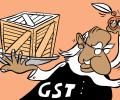
It is now becoming increasingly clear that rising imports have played a significant role in sustaining the buoyancy in revenues from GST, notes A K Bhattacharya.
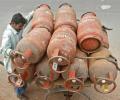
Officials said the oil marketing companies had provided data to the Income Tax department.

Meanwhile, Uttarakhand, Kerala and Delhi have already announced cut in value added tax on petrol.
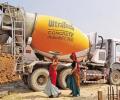
UltraTech Cement's results for the fourth quarter results of the 2022-23 financial year (Q4FY23) were broadly in line with the Street estimates. The consolidated revenue, operating profit and net profit stood at Rs 18,700 crore, Rs 3,300 crore and Rs 1,670 crore, respectively, which were up 18 per cent, 8 per cent and 13 per cent YoY, respectively.

Acceleration in demand, together with marginal price hikes of about 2-3 per cent by cement companies in the October-December quarter (third quarter, or Q3) of 2022-23, may not be enough to cushion the impact of high input costs on the bottom line, reveal Bloomberg consensus estimates for the quarter. Year-on-year (YoY) net sales growth in Q3 will come in at nearly 7 per cent, shows Bloomberg data, while bottom-line growth will show a sharp decline of 25 per cent from a year ago. The earnings before interest, tax, depreciation, and amortisation (Ebitda) will likely decline by nearly 5 per cent versus a year ago, shows data.
About 45 per cent of car sales since October have been diesel, but the capacity has been constrained.
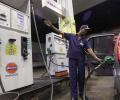
Petrol and diesel prices were hiked by 80 paise a litre each on Wednesday, taking the total increase in rates in 16 days to Rs 10 per litre.

The levy had to come into effect from April 1. It would now be in force from July 1.

The central government is likely to further consolidate its fiscal deficit by 50 basis points (bps) to 5.9 per cent in FY24 from 6.4 per cent in FY23, according to a recent report released by Goldman Sachs on Tuesday. In the current fiscal year, there is going to be an upside of 0.5 per cent on the receipts side due to higher nominal GDP growth, and higher tax buoyancy because of the formalisation, the report said. The upside to expenditure is mainly going to come from incremental subsidies (0.8 per cent of GDP), in both food and fertilizer, it said. The upcoming pre-election Budget will carry forward the trend of the increased capital expenditure seen in recent years.
World Bank, which plans to invest $1 billion a year in India's transport sector, on Friday proposed a separate 'road maintenance fund' through fuel tax and user charges for development of highways.

While an import duty is ruled out, a small excise duty on jewellery manufacturing can be on the cards.

India, which wants to double its coal output by 2020, in February raised the tax on mining coal to $6 per tonne from $1 in a bid to make it more expensive to consume the dirty fuel

Demonstrators have smashed and looted shops in Paris in a resurgence of the gilets jaunes ("yellow vest") protests that started four months ago in France. Here's a glimpse of what happened.
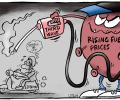
Petrol price on Thursday was hiked by 35 paise per litre and diesel by 15 paise, pushing rates to a new high across the country. Petrol in Delhi now costs Rs 101.54 a litre and diesel Rs 89.87 per litre, according to a price notification of state-owned fuel retailers. The increase comes after rates stayed mute for three days. Petrol price was last hiked on July 12, on a day when diesel rates had seen its first reduction in almost three months. The increase on Thursday neutralised the 16 paise price cut in diesel on July 12.
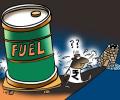
The GST Council might on Friday consider taxing petrol, diesel and other petroleum products under the single national GST regime, a move that may require huge compromises by both central and state governments on the revenues they collect from taxing these products. The Council, which comprises central and state finance ministers, in its meeting scheduled in Lucknow on Friday, is also likely to consider extending the time for duty relief on COVID-19 essentials, according to sources in the know of the development. GST is being thought to be a solution for the problem of near-record high petrol and diesel rates in the country, as it would end the cascading effect of tax on tax (state VAT being levied not just on the cost of production but also on the excise duty charged by the Centre on such output).

Indian Oil Corporation (IOC), Bharat Petroleum and Hindustan Petroleum may post a combined loss of Rs 10,700 crore in June quarter on selling petrol and diesel at rates below cost, a report said on Monday. While the raw material (crude oil) prices soared in April-June, petrol and diesel prices were not revised, leading to marketing losses which offset strong refining margins, ICICI Securities said in the report. The three state-owned oil marketing companies -- IOC, BPCL and HPCL -- control 90 per cent of the retail petrol and diesel sales in the country.
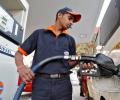
Diesel price on Monday went past the Rs 98-a-litre mark in a few places of Rajasthan as a relentless increase in fuel prices took rates to record-high levels. Petrol price was increased by 29 paise per litre and diesel by 26 paise a litre, according to a price notification of state-owned fuel retailers. The increase - 16th this month - pushed petrol and diesel prices to a fresh all-time high across the country. Sri Ganganagar district of Rajasthan saw petrol price climb to Rs 105.24 a litre and diesel to Rs 98.08 per litre.

Opposition members in the Lok Sabha on Monday blamed the Bharatiya Janata Party-led central government's policies for the price rise and accused it of ignoring the plight of common people, saying kitchens will soon "see a lockdown" if the Centre does not take corrective measures.
 © 2026 Rediff.com - Investor Information - Advertise with us - Disclaimer - Privacy Policy - Sitemap - Feedback - About us - Terms of use - Grievances